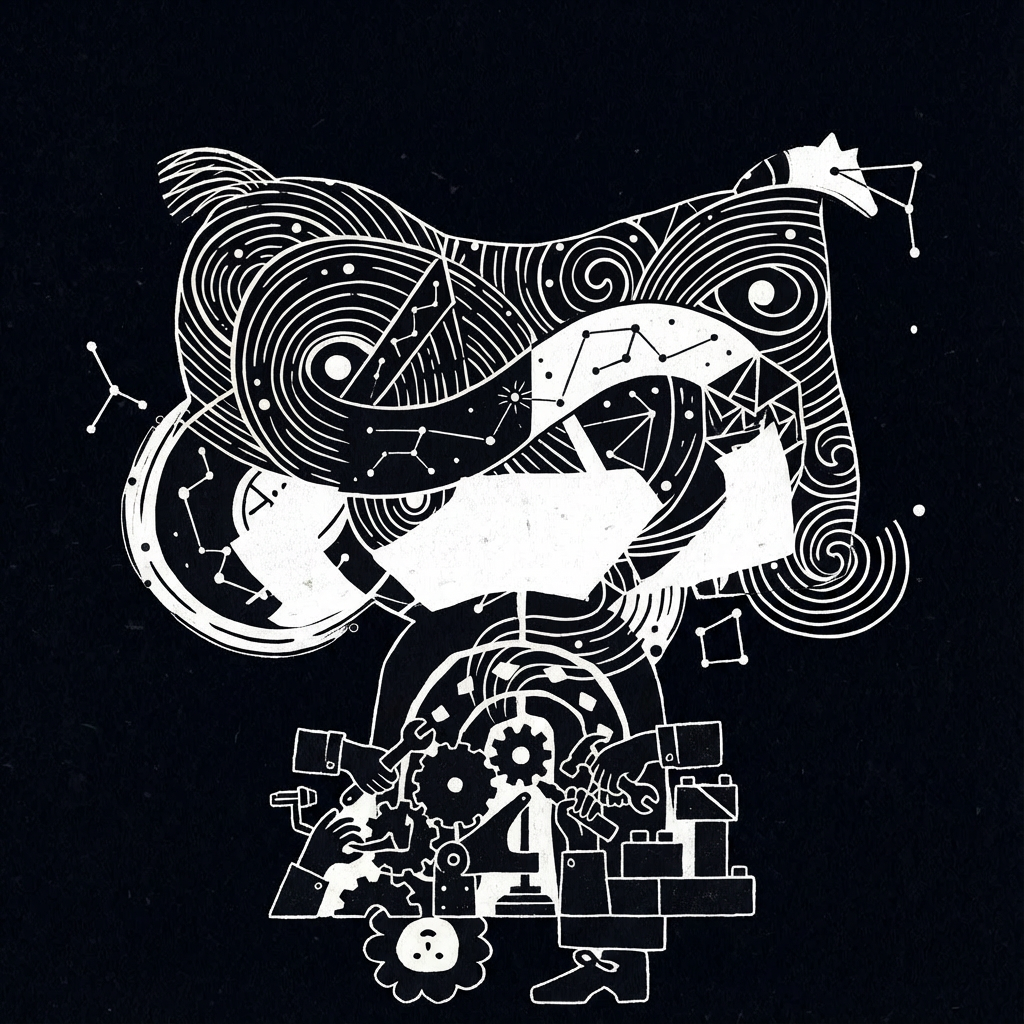
THE THINK
To design is to think, afterwards is production.
There is a quiet, almost private joy in thinking. Not the frantic kind of thinking that solves immediate problems, nor the anxious kind that chases outcomes—but the slow, generous thinking that belongs to design. This is thinking as exploration, as curiosity, as permission. It is the pleasure of allowing an idea to exist before it is asked to justify itself.
To design is, first and foremost, to think. Everything else follows.
In its purest state, design lives entirely in the mind. It is weightless, frictionless, and unburdened by budgets, gravity, materials, deadlines, or compromise. A thought can be perfect because it has not yet encountered resistance. It is whole. It is resolved. It is, for a fleeting moment, complete.
This is the enjoyment at the heart of design: the cultivation of thoughts for the purpose of positive creation. To think in this way is not indulgent; it is essential. It is where meaning is shaped before form appears. It is where intention is clarified before execution begins. It is where values quietly embed themselves into what will later become objects, spaces, experiences, and systems.
Only after this comes the secondary pleasure—the enjoyment of producing. Of illustrating, communicating, testing, refining, and finally realising those thoughts. Production is not lesser, but it is different. It is a translation. And like all translations, something is always gained and something is always lost.
We now live in an age rich with tools. Software, AI, machines, fabrication techniques, and platforms promise to help us make faster, smoother, and more convincingly than ever before. They assist us in turning dreamland thoughts into tangible things. They shorten distances between imagination and reality. They amplify our ability to produce.
But no matter how advanced these tools become, they cannot alter a fundamental truth: perfection can only exist in the mind.
The moment a thought is externalised—drawn, modelled, written, built—it enters the world. And the world is nuanced. Materials behave unexpectedly. Context interferes. People interpret. Constraints assert themselves. What was once perfect becomes negotiated. This is not failure; it is reality.
Design, in purity, is that perfect thought. Great design, however, is something else entirely.
Great design is a plant.
It begins as a seed—small, potent, and complete in itself. That seed is the original thought. The intention. The belief. The quiet clarity that existed before production began. The act of design, in its highest form, is not to force the seed into an exact replica of the imagined plant, but to nurture it into something that grows as close as possible to its original nature.
And yet, here is the nuance we must not forget: the path from seed to plant is never straight.
As ideas are produced, they are seen. As they are seen, they are understood differently. New options appear. New thoughts emerge. The act of making feeds back into the act of thinking. What felt resolved becomes questioned. What seemed fixed becomes flexible. This is not dilution—it is evolution.
The designer’s role, then, is not to cling rigidly to the first thought, nor to abandon it at the first sign of resistance. It is to walk the ever-changing path between intention and reality with attentiveness. To recognise which changes are betrayals of the seed, and which are necessary adaptations that allow it to survive.
To design is to think.
To produce is to accept imperfection.
To create well is to honour the thought, while allowing it to grow.
And in that tension—between purity and production, between seed and plant—design finds its quiet, enduring joy.